
By Tico Fantucci, the Tailor Cat of FANTUCCI
Look at that feathered face.
Huge angry eyes, a stone-cold expression, and absolutely no unnecessary movement. The owl just sits there in silence and stares at you as if you’ve suggested tucking your trousers into your socks.
Convincing? Of course.
There’s just one awkward detail: nobody has ever properly proved that an owl is smarter than your average back-alley pigeon.
And yet humanity has spent thousands of years turning this bird into a symbol of knowledge. We put owls on emblems, surround them with books, stick academic caps on their heads, and generally behave as if this nocturnal predator defended a PhD in structural engineering yesterday.
Ha. One hell of a career move for a professional mouse eater.
So who started this fake news?
All Roads Lead to Athens
Ancient Greece is involved, as it so often is when humanity has been repeating the same idea for a suspiciously long time.
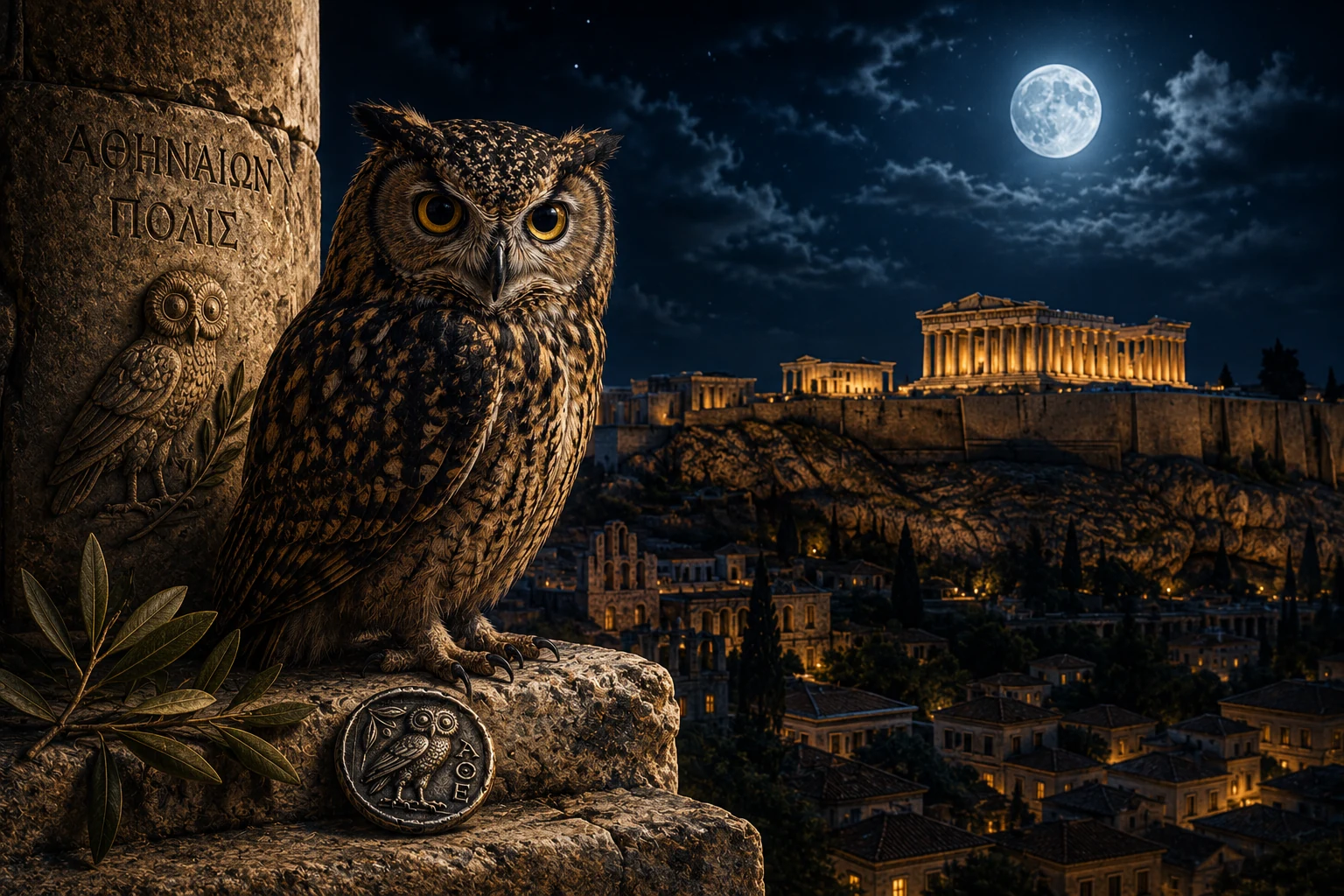
The owl became firmly associated with Athena, the goddess of reason, crafts, strategy, and carefully planned ass-kicking. The Greeks also had Ares, who handled rage, blood, screaming, and the sort of conflict where you swing the metal thing first and try to remember what the argument was about later.
Athena represented a different approach, built around calculation, discipline, and having something resembling a plan. Personally, I respect that. Especially in tailoring, where you measure three times, cut once, and only then decide whether the scissors should be applied to the fabric or to the person who brought you a jacket with sleeves of different lengths.
Owls regularly appeared beside Athena in ancient Greek art. Wherever the goddess went, there was the bird with the facial expression of a tax inspector.
But being associated with a goddess is one thing. Becoming an international symbol of brains is quite another, and for that you need marketing.
The finest marketing machine of the ancient world had a very simple name: money.
The Owl Got on the Money
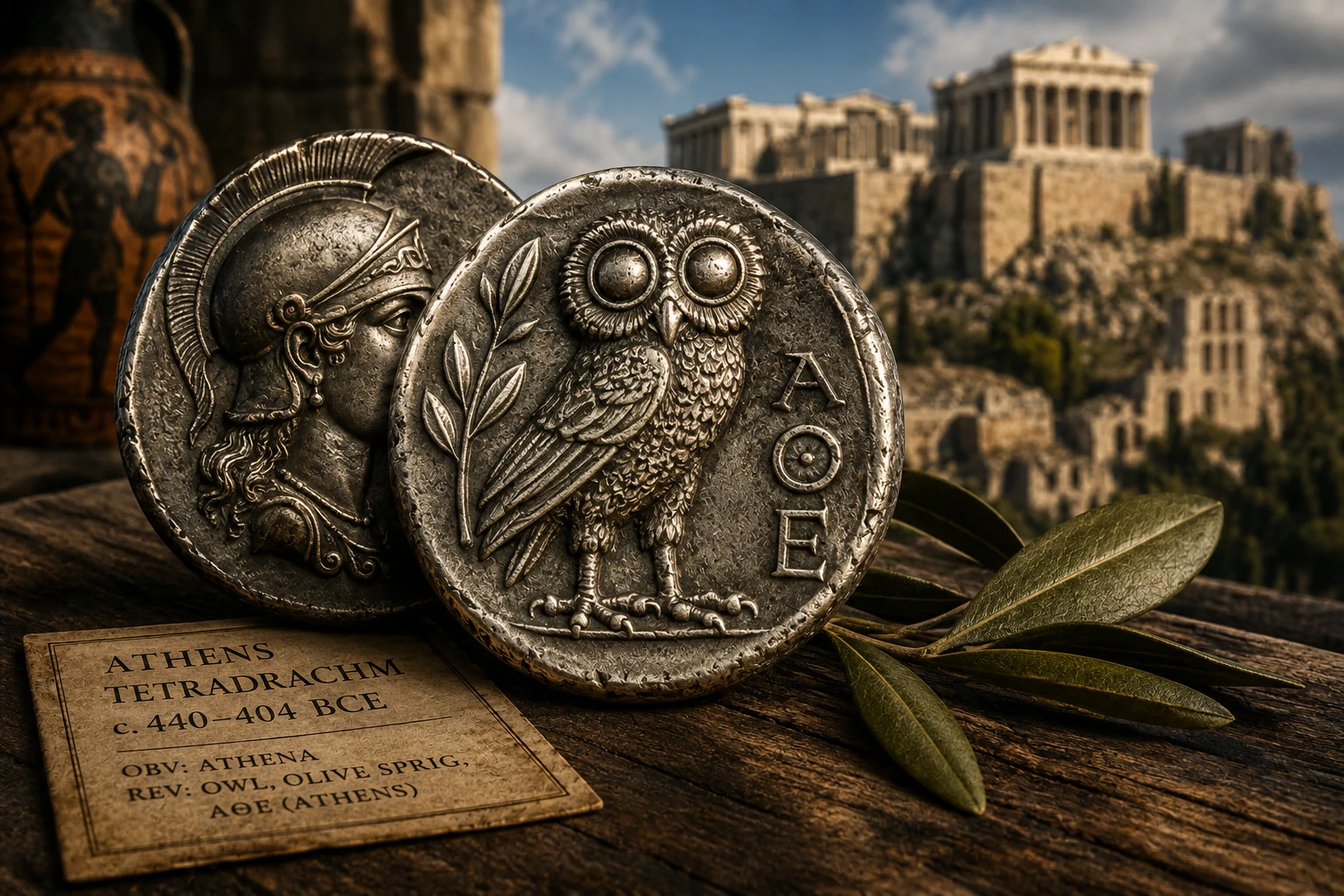
Athenian silver tetradrachms had a design almost as simple as a good suit. Athena’s head appeared on one side, while the other carried an owl, an olive sprig, and the mark of Athens.
That was it. There were no gradients, no rebranding every three years, and no creative director demanding that the owl feel “more human and engaging for younger audiences.”
And it worked for centuries.
Athenian coins circulated widely around the Mediterranean, where people knew them, accepted them, and passed them from hand to hand. A man could have never seen the Parthenon, known nothing about Greek mythology, and considered every philosopher a suspicious bastard in sandals, but he could still recognize the coin.
Again and again, the same combination appeared: Athena and the owl, the owl and Athena.
Aha. Welcome to ancient neuromarketing.
The bird gradually became more than a bird. It carried associations with Athena, Athens, and the intellectual aura surrounding the whole package.
This is also where we should avoid cooking up historical soup. There is no good reason to imagine the ancient Greeks gathering an owl, a raven, a parrot, and a pigeon in one room and giving them an entrance exam before announcing, “Gentlemen, the owl scored 147. We have our winner.”
The connection between Athena and the owl is real and well established. The idea that the bird was chosen specifically because of its extraordinary intelligence is much shakier.
The cultural logic may even work the other way around. Perhaps we think the owl is wise because humans spent centuries seeing it beside the right goddess.
To Be Fair, It Has the Right Face
Nature certainly didn’t hurt the campaign.
Look at your average pigeon, with one eye over here, another somewhere around the corner, its head bouncing as it walks with the confidence of a man who has just stolen a bread roll and feels absolutely no remorse.
Now look at an owl. Its enormous eyes face forward, the facial disc frames the whole operation, and the heavy, steady stare makes it look less like the owl is confused and more like you are the one who has misunderstood something important.
The owl does not need to perform. It can sit quietly, stare at you, and allow the human brain to do all the work.
Hmm. Here’s a free life hack: if you have absolutely no idea what to say, remain silent and look extremely serious. Within a few minutes, everyone around you will decide that you understood something before they did.
I built a career on it.
The Night Shift Helped Too
Then the owl clocks in for the night shift, and this part really is impressive.
Owls are superbly adapted to hunting in low light. Their hearing and vision help them locate prey in conditions where a human has already spent ten minutes crawling around on all fours looking for the light switch.
We hear a strange rustle and wonder what the hell it was. The owl hears the same thing and starts thinking about dinner. We look into the darkness and see darkness, while the owl looks into it and sees another working day.
How could humans possibly resist making myths out of that?
The symbolism practically writes itself. Darkness means the unknown, and the owl can operate in darkness, so it becomes very easy to imagine the bird as a creature capable of seeing what remains hidden from everyone else.
It is beautiful, elegant, and almost philosophical.
Biology, however, never signed a contract saying that night vision automatically comes with a diploma in wisdom.
So Is the Owl Smart, or Did We Make the Whole Thing Up?
Now we get to the good part.
If you judge birds by the mental tricks humans find particularly impressive, owls have some serious competition. Corvids, for example, are a proper feathered mafia. Crows and their relatives can solve complex problems, manipulate objects, and show the sort of flexible behavior that makes you suspect they have been planning something for years and simply don’t consider us important enough to explain it.
Parrots aren’t exactly decorative screaming furniture either.
The owl, meanwhile, is excellent at owl business. It hunts, listens, waits, reacts, works nights, and never feels the slightest need to explain itself to humans.
But put owls in front of puzzles designed by humans, and the legend of the feathered professor starts looking slightly less majestic.
In one experiment, great grey owls faced a string-pulling task involving food. The basic idea was simple enough: interact with the right string and get the reward. The owls did not exactly deliver an intellectual massacre.
Let’s put it this way. The Nobel Committee did not call.
Does that make an owl stupid? Pff. A human cannot locate a vole by sound in the dark, and you don’t hear me announcing that Homo sapiens is a failed project, although some days the evidence does pile up.
An owl is beautifully equipped for owl problems. Humans simply handed it the professor’s diploma without making it sit the exam.
And that is exactly why I like the owl as a graphic image. It stopped being merely a bird a very long time ago and picked up an entire personality along the way: the stare, the calm, the night, the mystery, the intelligence, and that faint expression of “I understood everything, but I’m not explaining it to you.” Those characters feel right at home at FANTUCCI, and if you want to wear a creature that looks smarter than half the meeting before anyone has opened their mouth, an owl is suspiciously well qualified.
Wear the Wisdom

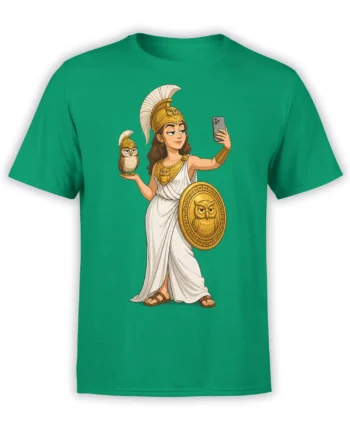
Ancient Owl Warrior T-Shirt | Unisex
Price range: $21.99 through $23.99 Select options This product has multiple variants. The options may be chosen on the product page-
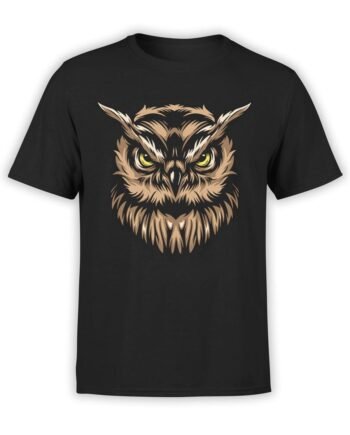
Angry Owl T-Shirt | Unisex
$21.99 Select options This product has multiple variants. The options may be chosen on the product page -
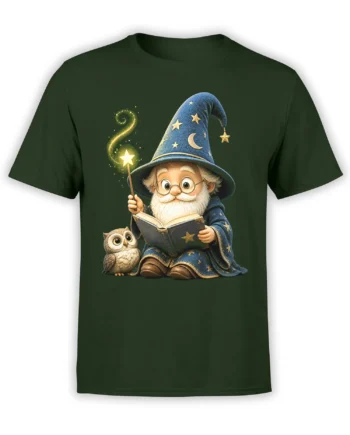
Arcane Scholar Fantasy T-Shirt | Unisex
Price range: $21.99 through $23.99 Select options This product has multiple variants. The options may be chosen on the product page -
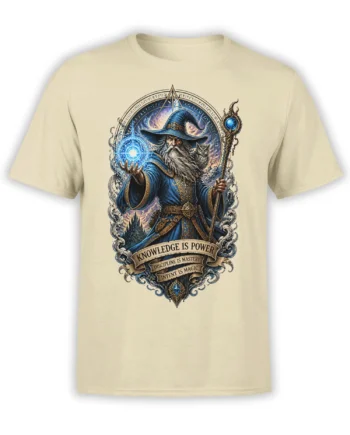
Arcane Scholar Wizard T-Shirt | Unisex
Price range: $21.99 through $23.99 Select options This product has multiple variants. The options may be chosen on the product page
Wise Owl? Depends Who You Ask
The funniest part is that wisdom was never the owl’s only career. In some cultures and periods, a nocturnal bird could stand beside knowledge, while elsewhere the same creature looked like very bad news.
And I understand why.
Imagine yourself alone in a forest at night. It is pitch black, nothing is moving, and suddenly something above you makes a sound that was clearly not included in the original specifications for a normal life. Then two eyes appear in the darkness.
Oh yes, of course. Wisdom has arrived.
European traditions have also associated owls with bad omens, death, darkness, and the supernatural. The same bird could therefore perform completely different symbolic jobs depending on who was looking at it.
Beside Athena, it sits next to reason. On a cemetery branch, it looks more like an employee from the Department of Advance Notice.
Same source material, different copywriting.
Then Hegel Arrived and Made Everything Complicated Again
Eventually, ancient Athens disappeared, its famous coins stopped circulating, and the old gods moved into museums. You might think someone would finally leave the owl alone.
No such luck.
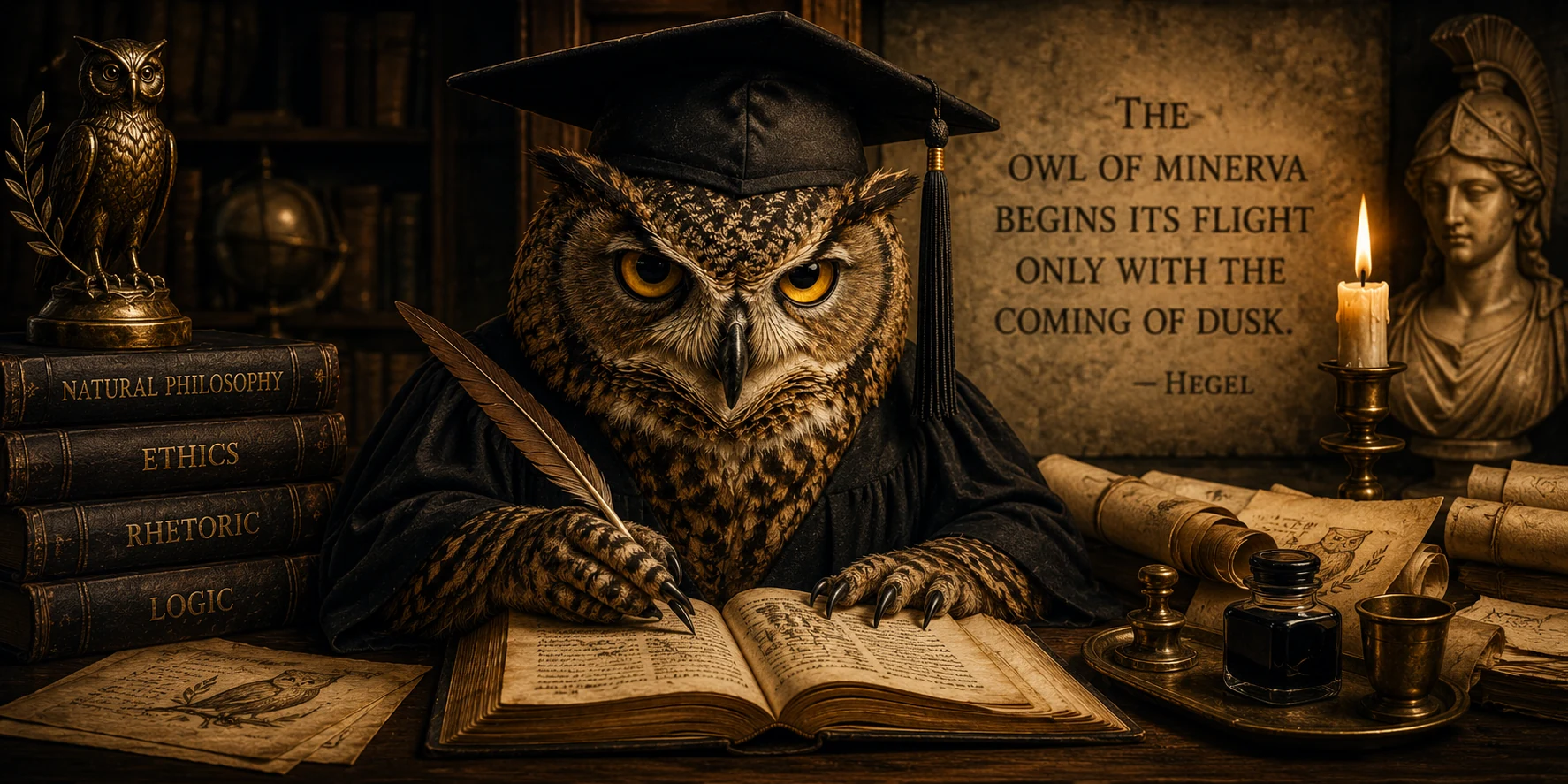
In the nineteenth century, German philosopher Georg Wilhelm Friedrich Hegel dragged it back onto the stage with his famous image of the Owl of Minerva beginning its flight only with the coming of dusk.
If we resist bullying philosophy for a moment, the idea is actually a good one. We often begin to understand an era only when it is already reaching its end. While everything is happening, people are too busy living through the mess to understand its full shape. Later, they sit down, examine the consequences, and finally realize what was going on.
In other words, first make the mess, then write three volumes about the nature of mess.
Ha. Humanity does enjoy a reliable workflow.
Once again, the owl was perfect for the job: a nocturnal bird appearing when the day is already over, carrying the idea of wisdom that arrives just a little too late to be useful.
So Why the Owl?
By now, the whole operation is fairly easy to see. Take a bird with an extremely convincing face, place it beside one of the smartest goddesses of the ancient world, stamp the pair onto enormous quantities of silver coins, and send those coins along major trade routes. Then add night hunting, giant forward-facing eyes, and an uncanny ability to notice things we miss.
Give the mixture a couple of thousand years, and you have a wise owl.
There was no conspiracy and, sadly, no secret owl university. What we got instead was one of the most successful branding jobs in human history.
That may be the best part of the whole story, because somewhere along the way we stopped looking at the actual bird. We began looking at everything humanity had piled onto it: knowledge, night, mystery, calm, observation, and a certain kind of arrogant silence.
That last one is particularly admirable.
Meanwhile, the real owl is sitting on a branch, looking at humanity like a herd of idiots and thinking exclusively about where to find a juicy mouse.
Well.
Maybe we weren’t completely wrong about the wisdom after all.